

Faculty Mentor
Dr. Elaine Vanterpool
Files
Download Full Text (951 KB)
Description
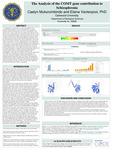
The COMT gene, also known as the catechol-O-methyltransferase gene, plays a role in breaking down the neurotransmitters in the brain, like dopamine. Dopamine plays a role in behavior and mood; as a result, the COMT gene can influence traits like mental illnesses and disorders. COMT has a variation called Val158Met, where a change in the DNA sequence affects the efficiency of dopamine breakdown. Those who have the variant have lower COMT activity, which results in dopamine levels being high in the brain, which affects their ability to deal with stress and to show signs of aggressive behavior. This gene has also been linked to schizophrenia. •The COMT gene provides instructions for making the enzyme catechol-O methyltransferase, mainly made in the brain cells. There are two versions of the enzyme. The longer version is called the membrane-bound catechol-O methyltransferase, and the shorter version is called soluble catechol-O methyltransferase. This shorter version is produced in all the other body parts and helps to maintain certain hormones. The COMT enzyme breaks down chemicals like neurotransmitters, which are mainly responsible for sending signals between the nerve cells in the brain. The COMT is 27.22 kb in length and is found on chromosome 22. It’s extremely important in the prefrontal cortex. This part of the brain is known to control planning, thinking, emotion, and short-term memory. For the prefrontal cortex to work efficiently, it must have the correct number of neurotransmitters like dopamine. The enzyme helps keep these chemicals at the right levels in this part of the brain. According to the National Library of Medicine,” Studies of COMT Val158Met suggest that the neural circuitry subserving inhibitory control may be modulated by this functional polymorphism, altering cortical dopamine availability, thus giving rise to heritable differences in behaviors.” •The COMT gene also plays a role in aggressive behavior in humans. Aggression is an important part of survival in humans; when it becomes excessive, it can lead to negative outcomes. According to the National Library of Medicine, aggression has a strong hereditary component with up to 40-50% risk of being genetic. Craig and Halton conducted studies and found that various genes, including the COMT gene, have been linked to aggression. There have also been studies that look at aggression and the COMT through the lens of schizophrenia. The study showed that the” low-activity MetMet allele had a higher risk for these dangerous behaviors than the high-activity ValVal homozygotes.” The COMT, among other environmental factors plays a role in aggressive behavior and can be linked to other diseases but research is most definitely still ongoing.
Publication Date
4-1-2025
City
Huntsville
Disciplines
Biology
Recommended Citation
Vanterpool, Elaine and Mukorombindo, Caelyn, "The Analysis of the COMT gene contribution to Schizophrenia" (2025). Student Posters. 150.
https://ouscholars.oakwood.edu/student-posters/150
Comments
Caelyn Mukorombindo, Student Researcher