

Faculty Mentor
Dr. Elaine Vanterpool
Files
Download Full Text (552 KB)
Description
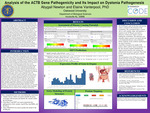
Dystonia is a neurological movement disorder characterized by involuntary spasms or contractions of the muscles in one or more areas of the body, which may or may not be accompanied by pain. Over 250,000 people in the United States have been diagnosed with dystonia, making it one of the three most common neurological motor diseases in the country. Dystonia does not discriminate; it can affect anyone, regardless of race or age. However, women are diagnosed with this disease at twice the rate of men. The precise cause of dystonia remains unclear, but it can be hereditary. Fortunately, we have identified the part of the brain affected by dystonia. This condition arises due to abnormal functioning of the basal ganglia, a structure located deep within the forebrain that plays a crucial role in coordinating movement. Unfortunately, the exact cause of dystonia remains unknown. The ACTB gene is responsible for producing a protein called beta-actin, which is a key component of the cell's cytoskeleton. The ACTB gene is mainly found in the stomach, which is significant because if a person digests food regularly, the stomach will conduct peristalsis consistently throughout the day. It is also found in other organs that conduct movement on a daily basis, like the lungs, intestines, and heart. Since this gene is essential for maintaining cell shape, migration, and motility, mutations in it can impact the body’s movement. The ACTB gene is directly linked to Braraitser Winter syndrome, a developmental disorder that affects the brain, eyes, and other facial features. However, further analysis is needed to better understand the relationship between mutations in the ACTB gene and dystonia.
Publication Date
4-2025
City
Huntsville
Disciplines
Biology
Recommended Citation
Vanterpool, Elaine and Newton, Abygail, "Analysis of the ACTB Gene Pathogenicity and Its Impact on Dystonia Pathogenesis Abygail Newton and Elaine Vanterpool, PhD" (2025). Student Posters. 177.
https://ouscholars.oakwood.edu/student-posters/177
Comments
Abygail Newton, Student Researcher