

Faculty Mentor
Dr. Elaine Vanterpool
Files
Download Full Text (2.0 MB)
Description
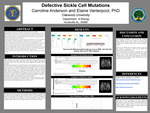
Sickle cell disease (SCD) is a group of inherited red blood cell disorders. It is an inherited hemoglobinopathy. Both alleles must be affected to manifest the disease. In sickle cell disease, the red blood cells become hard, sticky, and look like a sickle, making it difficult to pass through the blood vessels and carry oxygen. Sickle cell trait is more prevalent than sickle cell disease and affects 1 in 13 African American babies (According to the CDC). The clinical manifestation of sickle cell trait is not as aggressive and does not cause as much morbidity as sickle cell disease. This study aimed to identify the gene variants associated with sickle cell disease. To do this, we used Simple Clinvar, PolyPhen-2, and SIFT to do the analysis. Simple Clinvar was used to look up sickle cell and provide information on the disease. PolyPhen-2 was used to gain visuals on the mutations, as well as information on whether or not the mutation is benign. SIFT was used to confirm whether or not the mutation is benign. The variants that were chosen were the His114Arg variant and the Glu91Lys variant. These variants were chosen at random. After some analysis from PolyPhen-2, both variants were shown to be benign. SIFT predicted that the mutations do not affect protein function. From Simple Clinvar, 423 missense mutations were identified. There are 423 mutations that can manifest in sickle cell trait. The SNV mutation is consistently in sickle cell trait. Within the SNV mutation, there are different variants. One of the drawbacks in this research is that there are so many variants. Because of this, the research is ongoing.
Publication Date
4-1-2025
City
Huntsville
Disciplines
Biology
Recommended Citation
Vanterpool, Elaine and Anderson, Carroline, "Defective Sickle Cell Mutations" (2025). Student Posters. 127.
https://ouscholars.oakwood.edu/student-posters/127
Comments
Carroline Anderson, Student Researcher