

Faculty Mentor
Dr. Elaine Vanterpool
Files
Download Full Text (521 KB)
Description
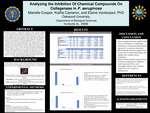
Pseudomonas aeruginosa is an opportunistic pathogen that poses significant challenges in clinical treatment due to its production of collagenase. This bacterium can cause several infections including pneumonia, meningitis, septicemia, and a host of other diseases. Collagenase acts as a key virulence factor by breaking down collagen in the host’s extracellular matrix, allowing bacteria to invade tissues. This study hypothesized that the effects of cell secreted collagenase would be inhibited by metronidazole, vanillin, and silver nanoparticles to reduce the pathogenicity of Ps. aeruginosa related infections. With the use of a spectrophotometric assay, collagenase activity was measured in treated and untreated bacterial cultures. The results displayed that silver nanoparticles and vanillin significantly inhibited collagenase activity up to 98-99%. This indicates their potential to deliver a new approach to treatment of pathogenicity associated with Ps. aeruginosa. On the other hand, metronidazole exhibited limited efficacy in addition to appearing to cause a trigger in the initial increase in collagen production. The findings in this study suggest that silver nanoparticles and vanillin could serve as effective alternatives to traditional treatment for managing Ps. aeruginosa infections. Future studies should focus on optimizing dosage of these chemical compounds to display their clinical applicability which would be useful for reducing tissue damage and bacterial virulence.
Publication Date
4-1-2025
City
Huntsville
Disciplines
Biology
Recommended Citation
Vanterpool, Elaine, "Analyzing the Inhibition Of Chemical Compounds On Collagenase in P. aeruginosa" (2025). Student Posters. 131.
https://ouscholars.oakwood.edu/student-posters/131
Comments
Marielle Cooper, Student Researcher
KiaRa Cameron, Student Researcher