

Faculty Mentor
Dr. Elaine Vanterpool
Files
Download Full Text (535 KB)
Description
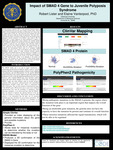
The SMAD family job is to aid in signal transduction of transforming growth factor �� (TGF ��), which is used as a growth hormone that aids in hyperpermeability of blood vessels, epithelial cell production, and cell differentiation. For the specific SMAD4 protein it has been to be a tumor suppressor gene that regulates the production of cells so that the abnormal production does not occur. However, with a mutated SMAD gene, these functions could be altered and cause drastic damage to the body. Learning how the SMAD 4 gene can cause diseases such as juvenile polyposis syndrome (JPS) and gastric adenocarcinoma with enteroblastic differentiation (GAED) would allow others to understand the effect of the gene. This can allow people to understand the impact of the SMAD 4 gene. JPS has been seen to cause issues within the gastrointestinal tract with the possibility of malignancy. When analyzing a pedigree, it was discovered that when the SMAD 4 gene was altered or replaced, the splicing function of the gene could not continue its function. With genetic testing the further analysis, it was determined that the gene was an autosomal dominant gene that will likely be seen in future generations. This study identified SMAD4 at c.424+5G>A to contribute to the pathogenicity of the gene and has been seen to cause several problems down the line.
Publication Date
4-1-2025
City
Huntsville
Disciplines
Biology
Recommended Citation
Vanterpool, Elaine and Lister, Robert, "Impact of SMAD 4 Gene to Juvenile Polyposis Syndrome" (2025). Student Posters. 144.
https://ouscholars.oakwood.edu/student-posters/144
Comments
Robert Lister, Student Researcher