

Faculty Mentor
Dr. Elaine Vanterpool
Files
Download Full Text (1.8 MB)
Description
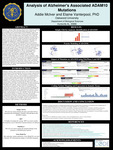
Alzheimer’s Disease (AD) is characterized by a loss of short-term memory and deterioration of the brain through a decrease in neuron connection and damage to the cerebral cortex. The main symptoms of AD are confusion and a loss of memory, reasoning, and social behavior, partially believed to be caused by neuritic plaque accumulation. This debilitating disease is associated with 28 genes and 515 variants. One of the rarer genes, ADAM10, is a cell surface protein/ protease that is part of the alpha secretase family, commonly associated with AD. These genes, present in all mammals, code for others in the ADAM family and cleave proteins like TNF-alpha and E-cadherins, which are important in stimulating cell growth and processing proteins. When these are unnaturally cleaved or regulated, they can promote cancers and beta amyloid accumulation. This accumulation often occurs when the amyloid precursor protein (APP) is left unprocessed by BACE1 or ADAM10 and is converted into amyloid plaques, causing buildup in nerve cells. ADAM10 variants also play a role in cortical basal syndrome, or shrinking of the brain, and reticulate acropigmentation of Kitamura, and are expressed in the adrenal glands, heart, intestine, kidney, lung, and stomach. The goal of this study is to investigate the pathogenicity of ADAM10 variants and understand how these mutations might contribute to AD and other diseases.
Publication Date
4-1-2025
City
Huntsville
Disciplines
Biology
Recommended Citation
Vanterpool, Elaine and McIver, Addie, "Analysis of Alzheimer's Associated ADAM10 Mutations" (2025). Student Posters. 173.
https://ouscholars.oakwood.edu/student-posters/173
Comments
Addie McIver, Student Researcher