

Faculty Mentor
Dr. Elaine Vanterpool
Files
Download Full Text (1.2 MB)
Description
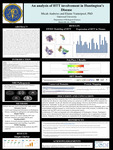
Huntington’s disease is a neurodegenerative disorder which affects every three to seven out of 100,000 individuals. Huntington’s is categorized by behavior change, such as reward perception, motivation, decision making, self perception, and struggle with interpersonal skills. Personality change, such as isolation, anxiety, and depression are also commonly seen in cases of Huntington’s. Even though dietary restrictions and physical exercise can slow the progression of Huntingtons, stress has shown to significantly contribute to the manifestation of Huntingtons disease. •Huntington’s disease is a genetic disorder causing atrophy of the brain over time, more specifically cortical and subcortical gray matter. •Most impacted by Huntington’s disease are the striatal neurons, found in subcortical gray matter. •Impact to these striatal neurons can also cause motor issues, such as involuntary jerking, muscle contractions, unusual eye movements, and trouble with speech or walking. •The HTT gene is essential in encoding for the protein, Huntingtin. This protein is essential for chemical signaling, transporting materials, attachment to proteins and other structures, and protecting the cell from apoptosis. •Proper functionality of HTT is necessary for normal function. •In cases of Huntington’s disease, the HTT gene has been mutated. •The purpose of this study was to identify these mutations and the effects they have on the pathogenicity of Huntington’s disease.
Publication Date
4-1-2025
City
Huntsville
Recommended Citation
Vanterpool, Elaine and Andrews, Micah, "An analysis of HTT involvement in Huntington’s Disease" (2025). Student Posters. 159.
https://ouscholars.oakwood.edu/student-posters/159
Comments
Micah Andrews, Student Researcher