

Faculty Mentor
Dr. Elaine Vanterpool
Files
Download Full Text (1.7 MB)
Description
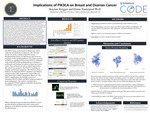
The PIK3CA gene can be found on chromosome 3q26.3 within the cell membrane of eukaryotic cells. The gene encodes for p110a, a subunit of the PI3k enzyme. Phosphoinositide kinases are lipid kinases that lead to the activation of vital signaling pathways. The primary function of PIK3CA is regulation of the normal cell cycle. Mutations of the PI3K/AKT/mTOR signaling pathways contribute to proliferation and formation of tumors in breast and ovarian cancer. These mutations can lead to cellular hyperactivity that can become oncogenic. The PI3K3CA mutation can stimulate growth factor production. The National Library of Medicine concluded that PIK3CA mutations were linked to estrogen receptor (ER), progesterone receptor (PR), and other breast cancer subtype upregulation (Ren et al.). The PIK3CA amplification was mutually exclusive to subsequent PIK3CA, KRAS, and BRAF mutations leading to tumor pathogenesis. The evidence concluded that a dysregulated PI3K/AKT pathway could affect the presence of epithelial ovarian cancer. PIK3CA-Related Overgrowth Spectrum (PROS) is used to describe disorders including breast and ovarian cancer. Mutations of the PIK3CA can lead to uncontrolled growth in the affected tissue.
Publication Date
4-1-2025
City
Huntsville
Disciplines
Biology
Recommended Citation
Vanterpool, Elaine and Krigger, Kaylani, "Implications of PIK3CA on Breast and Ovarian Cancer" (2025). Student Posters. 166.
https://ouscholars.oakwood.edu/student-posters/166
Comments
Kaylani Krigger, Student Researcher