

Faculty Mentor
Dr. Elaine Vanterpool
Files
Download Full Text (1.2 MB)
Description
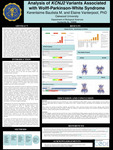
The KCNJ2 gene encodes the Kir2.1 protein, an inwardly rectifying potassium (K+) channel that plays a critical role in maintaining the resting membrane potential and contributing to the repolarization phase of cardiac action potentials. This protein is predominantly expressed in cardiac tissues, including ventricular myocytes and Purkinje fibers, where it mediates the inward rectifier potassium current (IK1). The proper function of Kir2.1 is essential for stabilizing the electrical activity of the heart and ensuring rhythmic and coordinated cardiac contractions. In human physiology, Kir2.1 channels help maintain the balance of intracellular potassium ions, contributing to cellular excitability and communication. These channels exhibit unique gating properties, allowing potassium ions to flow more easily into cells than out, particularly at hyperpolarized membrane potentials. This characteristic is crucial for maintaining a stable resting membrane potential in excitable cells, particularly in the myocardium, where precise electrical signaling is necessary for effective heart function. The KCNJ2 gene and its encoded Kir2.1 protein are implicated in several human diseases, primarily through genetic mutations and acquired dysfunctions. One significant genetic disorder associated with KCNJ2 mutations is Andersen-Tawil Syndrome (ATS), a rare multisystem channelopathy characterized by periodic paralysis, ventricular arrhythmias, prolonged QT intervals, and characteristic facial dysmorphisms. The mutation c.652C>T (p. Arg218Trp) in the KCNJ2 gene has been identified as a causative variant in ATS, as highlighted in a recent family case study. This mutation leads to phenotypic variability, including muscle weakness, metabolic syndrome, and cardiac complications such as myocardial infarction. The incomplete penetrance and diverse clinical presentations of ATS make its diagnosis challenging. Additionally, the role of KCNJ2 in the maturation of human-induced pluripotent stem cell-derived cardiomyocytes (iPSC-CMs) has gained attention in recent research. Overexpression of KCNJ2 in iPSC-CMs enhances their electrophysiological and structural maturation, promoting a more adult-like cardiomyocyte phenotype. These advanced cellular models provide valuable insights into the mechanisms of cardiovascular diseases and offer a platform for drug testing, including screening for drug-induced cardiotoxicity. The ability to manipulate Kir2.1 expression in vitro opens new therapeutic avenues for precision medicine and the development of personalized treatments for cardiac disorders. In conclusion, the KCNJ2 gene and Kir2.1 protein are vital components of cardiac function and play significant roles in both inherited and acquired heart diseases. Advances in understanding their function and regulation are paving the way for novel therapeutic strategies to treat conditions such as Andersen-Tawil Syndrome and improve the utility of iPSC-CMs in cardiovascular research and drug development.
Publication Date
4-1-2025
City
Huntsville
Disciplines
Biology
Recommended Citation
Vanterpool, Elaine, "Analysis of KCNJ2 Variants Associated with Wolff-Parkinson-White Syndrome" (2025). Student Posters. 156.
https://ouscholars.oakwood.edu/student-posters/156
Comments
Kerenlaime Bautista M., Student Researcher